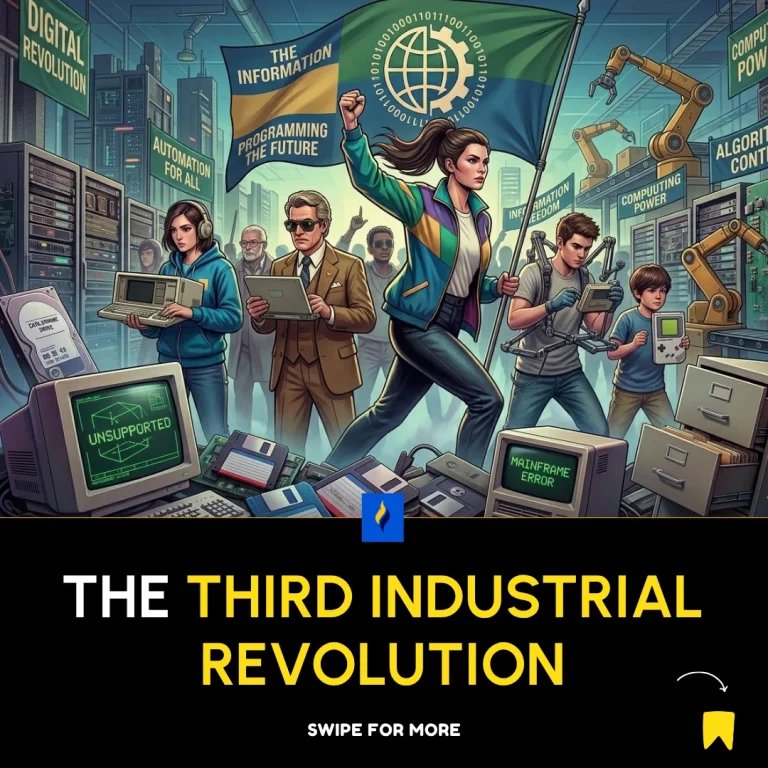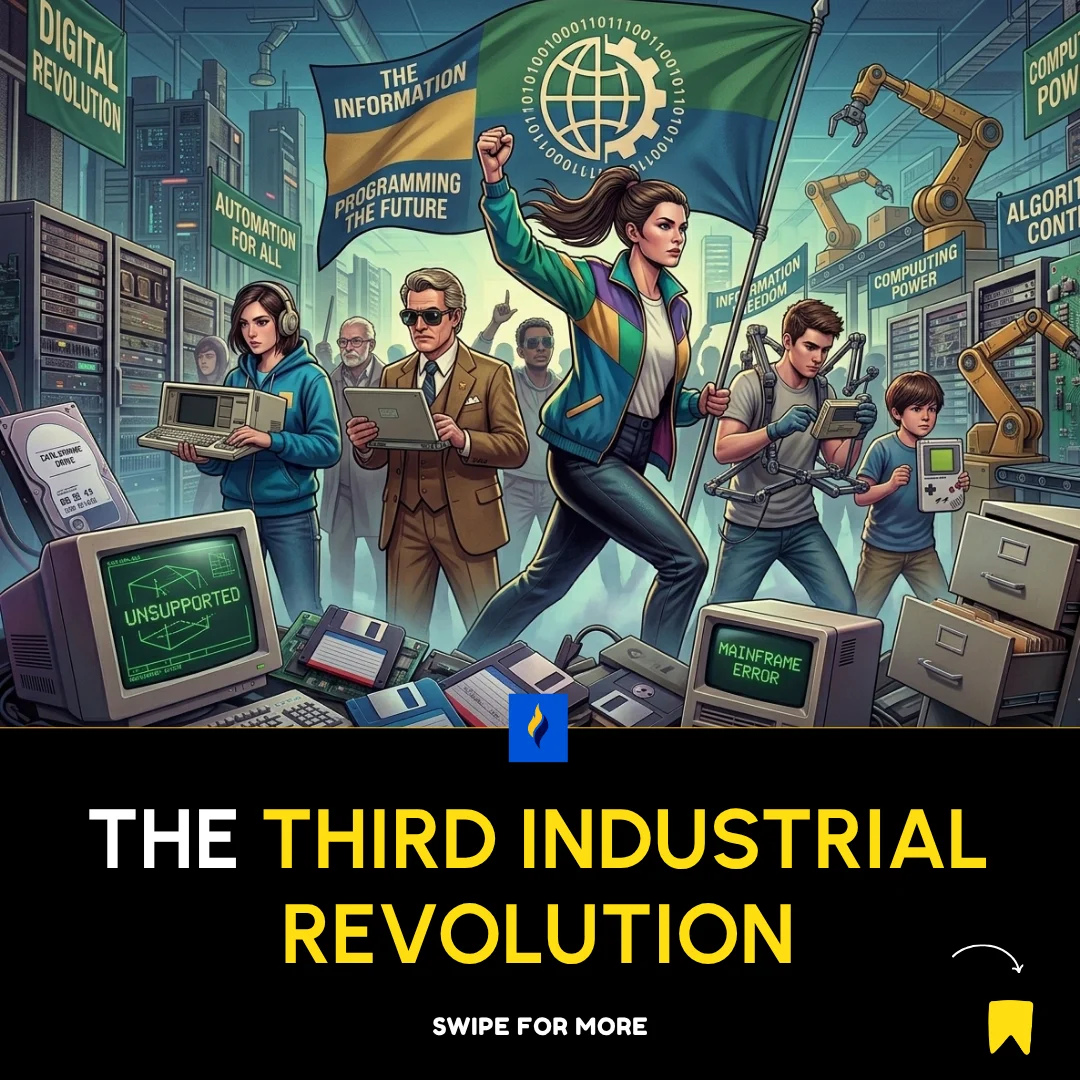
The Third Industrial Revolution refers to the transformative period in which digital technologies replaced analog and mechanical systems, fundamentally altering how societies produce, communicate, and operate. Emerging in the mid-to-late 20th century, it bridges the gap between traditional industrial systems and today’s intelligent, data-driven world.
Get software development guides here

1. Definition and Core Idea
The Third Industrial Revolution is defined by the shift from electromechanical and analog processes to digital electronics and information technology. At its core is the ability to convert real-world information into binary code, enabling machines to store, process, and transmit data at unprecedented speed and scale.
Unlike earlier revolutions driven by steam or electricity, this phase is driven by information—how it is created, manipulated, and distributed.
2. Historical Context
To understand its significance, it helps to position it within the broader industrial timeline:
- First Industrial Revolution: Mechanization powered by steam engines
- Second Industrial Revolution: Mass production enabled by electricity
- Third Industrial Revolution: Digital computing and automation
- Fourth Industrial Revolution: Intelligent systems (AI, robotics, IoT)
The Third Industrial Revolution acts as the foundation for the fourth, enabling the rise of smart technologies.
3. Key Milestones and Phases
a. Birth of Electronic Computing (1940s–1960s)
- Development of early computers like the ENIAC
- Use of vacuum tubes, later replaced by transistors
- Primary users: governments, military, and research institutions
b. Semiconductor and Microprocessor Era (1960s–1970s)
- Invention of the microprocessor, enabling smaller and more efficient computers
- Rapid advancements guided by Moore’s Law
- Foundation for personal computing
c. Personal Computer Revolution (1970s–1980s)
- Introduction of consumer-friendly systems like the Apple II
- Rise of software companies such as Microsoft
- Computers became accessible to businesses and households
d. Networking and the Internet (1990s–2000s)
- Expansion of the Internet
- Development of the World Wide Web
- Emergence of digital communication, e-commerce, and search engines like Google
e. Digital Convergence (2000s–2010s)
- Integration of computing, telecommunications, and media
- Rise of smartphones like the iPhone
- Cloud computing platforms such as Amazon Web Services
4. Foundational Technologies
1. Digital Electronics
Transition from analog signals to digital systems enabled precise, reliable computation.
2. Microprocessors
Compact chips that serve as the “brains” of computers and embedded systems.
3. Software Systems
Operating systems, applications, and programming languages that make hardware usable.
4. Networking Technologies
Infrastructure enabling global connectivity, including the Internet and telecommunications systems.
5. Data Storage & Processing
From magnetic tapes to cloud storage, enabling large-scale data handling.
5. Core Characteristics
- Digitization: Conversion of physical and analog data into digital form
- Automation: Machines performing tasks with minimal human intervention
- Miniaturization: Devices becoming smaller, faster, and more powerful
- Connectivity: Systems interconnected globally
- Scalability: Digital systems expanding rapidly with minimal marginal cost
6. Economic and Industrial Transformation
The Third Industrial Revolution redefined production and economic structures:
a. Shift to Knowledge Economy
Value moved from physical labor to information, skills, and intellectual capital.
b. Automation of Manufacturing
Introduction of computer-controlled machinery improved efficiency and precision.
c. Emergence of Digital Businesses
Entire industries (software, e-commerce, digital media) were created.
d. Globalization Acceleration
Digital communication enabled real-time global trade and collaboration.
7. Societal Impact
Communication
- Instant messaging, email, and social platforms replaced traditional communication methods
Education
- Digital learning platforms and access to global knowledge resources
Work Culture
- Rise of remote work, freelancing, and digital entrepreneurship
Lifestyle
- Smart devices, online services, and digital entertainment reshaped daily life
8. Advantages
- Increased Productivity: Automation and computing speed
- Global Access: Information and services available worldwide
- Innovation Ecosystem: Rapid development of new technologies
- Cost Efficiency: Reduced operational and production costs
- Convenience: Seamless integration of services into daily life
9. Challenges
Digital Divide
Unequal access to technology across regions and socioeconomic groups
Cybersecurity Risks
Increased vulnerability to hacking, data breaches, and cybercrime
Job Displacement
Automation replacing repetitive and low-skill jobs
Data Privacy Concerns
Mass data collection raising ethical and regulatory issues
Technological Dependence
Critical reliance on digital systems for essential services
10. Transition to the Fourth Industrial Revolution
The Third Industrial Revolution laid the groundwork for advanced technologies such as:
- Artificial Intelligence
- Robotics and automation systems
- Internet of Things (IoT)
- Big data analytics
- Blockchain and decentralized systems
These innovations define the Fourth Industrial Revolution, which builds on digital infrastructure to create intelligent, autonomous systems.
11. Conclusion
The Third Industrial Revolution represents a fundamental turning point in human history—where information became the primary driver of progress. By digitizing the world, it unlocked unprecedented levels of efficiency, connectivity, and innovation.
Its legacy is not just technological advancement, but a complete reconfiguration of economies, societies, and human interaction—setting the stage for the intelligent systems that now define the modern era.
About the Author

Latest tech news and coding tips.