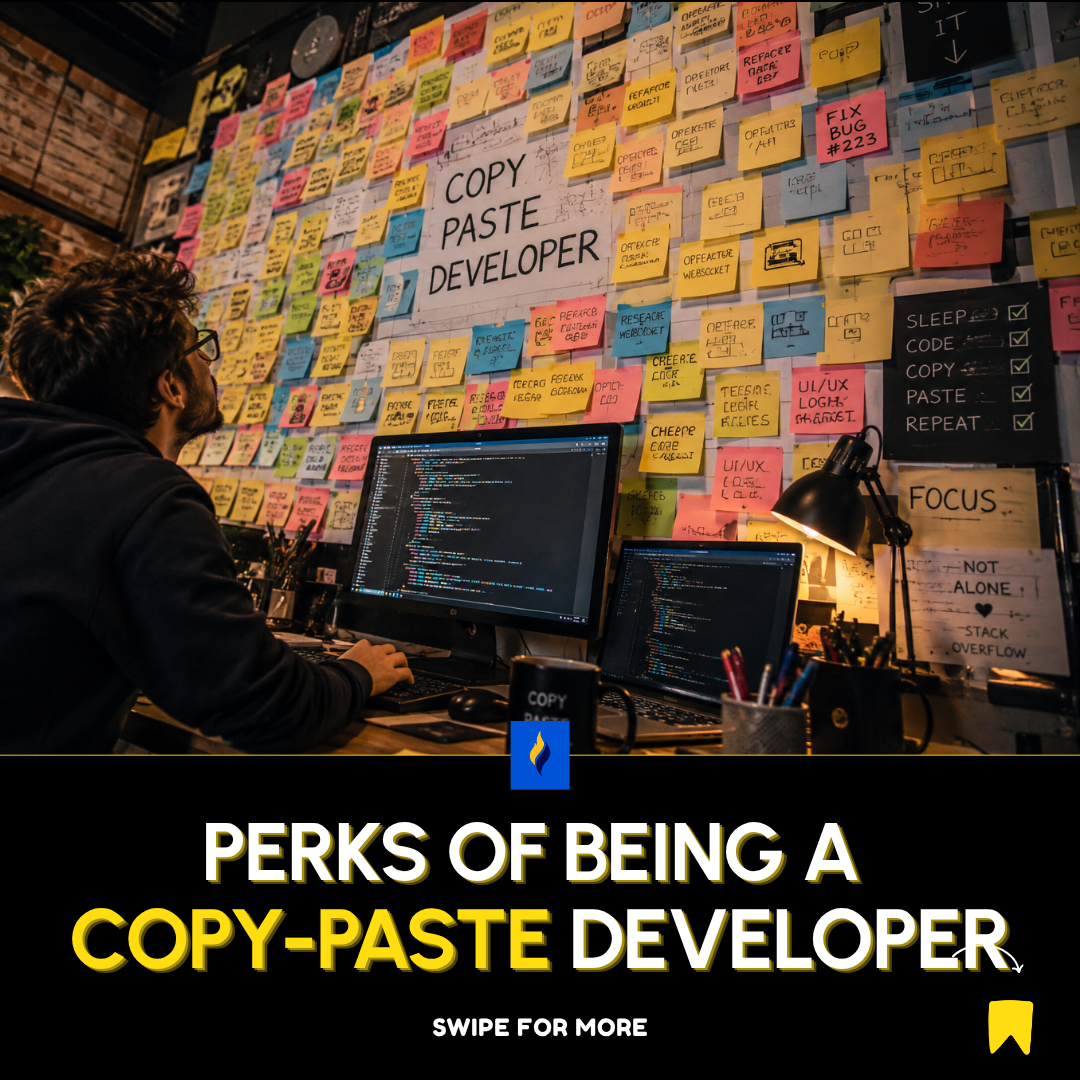
Why borrowing code is a skill—when you understand what you’re copying.
For years, “copy-paste developer” has been used as an insult. If someone copied code from Stack Overflow, GitHub, or documentation, they were often dismissed as someone who didn’t know how to program.
Learn on the Go. Download the Codeflare Mobile App from Google Play Store.
But here’s the truth:
Every experienced developer copies code.
The difference isn’t whether you copy code—it’s what you do after you paste it.
1. You Build Faster
Software development is rarely about reinventing the wheel.
Need a debounce function?
Need authentication middleware?
Need a responsive navbar?
If someone has already solved the problem well, why spend hours rebuilding it?
Copying proven solutions lets you focus on solving your actual business problem instead of recreating common utilities.
Speed matters.
2. You Learn Real-World Patterns
Tutorials usually teach ideal scenarios.
Open-source projects teach production code.
When you copy snippets from experienced developers, you’re exposed to:
- Better folder structures
- Cleaner functions
- Advanced JavaScript features
- Better naming conventions
- Performance optimizations
Every snippet becomes a mini lesson.
3. You Discover New APIs Faster
Imagine trying to memorize every React hook, Node.js module, CSS property, or SQL command.
Impossible.
Instead, developers search for examples, copy them, tweak them, and eventually remember the patterns naturally.
Copying accelerates learning.
4. Documentation Is Made to Be Copied
Look at any official documentation.
React.
Node.js.
Express.
Next.js.
Python.
They’re filled with code examples.
Why?
Because documentation expects you to copy the examples into your project and adapt them.
That’s the intended workflow.
5. You Spend More Time Solving Problems
Users don’t care whether your code came from memory.
They care that:
- The login works.
- The checkout succeeds.
- The app doesn’t crash.
- Pages load quickly.
Great developers optimize for delivering value—not for proving they can type every line from memory.
6. You Learn by Reverse Engineering
One of the best ways to improve is to ask questions after pasting code.
For example:
- Why is this
useEffectdependency array empty? - Why is this function asynchronous?
- Why is
useMemoused here? - Why is this query indexed?
The copied code becomes a classroom.
7. AI Makes Copy-Paste Even More Powerful
Today, developers copy code from AI assistants just as often as from search engines.
The real skill is:
- Reading the code
- Understanding it
- Testing edge cases
- Modifying it
- Knowing when it’s wrong
AI writes code.
Developers validate it.
But There’s a Catch
Being a copy-paste developer becomes a problem when you:
- Paste code without reading it.
- Ignore security implications.
- Leave unused code everywhere.
- Copy outdated solutions.
- Can’t explain what the code does.
- Depend on copying for every small task.
That’s not leveraging existing knowledge—that’s programming blindly.
The Best Developers Copy Intelligently
Senior developers copy.
Staff engineers copy.
Open-source maintainers copy.
Everyone copies.
The difference is that experienced developers:
- Understand what they paste.
- Adapt it to their project.
- Remove unnecessary parts.
- Improve it.
- Know when to write their own solution.
They don’t copy because they can’t code.
They copy because their time is valuable.
Final Thoughts
Programming has never been about memorizing every function or writing every line from scratch.
It’s about solving problems efficiently.
So don’t be ashamed of copying code.
Be ashamed of shipping code you don’t understand.
Copy code. Learn from it. Improve it. Then make it your own.
About the Author